

How the Dinner Roll Changed Skiing
On the Olympic stage in 2002, Jonny Moseley proved that the moves that don’t medal today often shape the sport of tomorrow.
“Can you imagine? Training your whole career for that moment, and then taking that risk?”
I’m sitting in a South Lake Tahoe breakfast diner, swapping 2026 Olympic predictions with pro skier and Helly Hansen athlete Marcus Caston, one week before the Opening Ceremonies in Milan-Cortina. The coffee is hot, our plates are half-finished, and the conversation has drifted somewhere unexpected.
Instead of debating who might medal this year, we’re talking about one Olympian who didn’t. The 2002 Salt Lake Games. Jonny Moseley... The Dinner Roll.
“Back then, flips were illegal in mogul skiing,” Marcus explains. “And the Dinner Roll was definitely close to inverted. He knew the judges wouldn’t like it. But he did it anyway.”
He pauses.
“Jonny Moseley changed skiing forever.”
-
-
Moseley had arrived at the Salt Lake Games four years after claiming gold in ‘98 not only to defend his title, but to push mogul skiing forward.
In Nagano, he had won with a 360 mute grab, but by 2002, that trick had already become standard. Moseley didn’t want to repeat it. He came to Salt Lake City with something new.
Enter the Dinner Roll. Moseley’s innovation.
But the sport he was returning to wasn’t the same freewheeling arena that had birthed freestyle skiing decades earlier. By 2002, mogul skiing operated inside a rigid scoring structure. Athletes were evaluated by seven judges: five for turns, which made up 50% of the overall score, two judges for air, which made up 25% of the score, with the remaining 25% coming from ‘time points’ based on how quickly athletes completed the course. Inverted tricks were illegal. Skis above the head? Automatic violation.
Upon its debut, the Dinner Roll immediately faced three obstacles:
First - legality. In its earliest form, the trick was borderline illegal. The trick involved two horizontal revolutions in an off-axis flip-like motion, flirting with inversion. Moseley spent hours perfecting the form, just barely making it something the rulebook would accept.
Second - speed. The trick required a slower, more controlled approach into the kicker. And with 25% of the score tied to time, attempting a more technical trick came at a cost.
Third - perception. Mogul judges had never evaluated a trick like the Dinner Roll. Even if executed perfectly, would they understand its degree of difficulty? Jeff Wintersteen, Moseley’s coach, summed it up. “This could be a masterpiece and still get graded like a messy book report.”
Moseley understood all of this. But he wanted to do it anyway.
Athletes, he believed, had fallen into a loop, recycling the same tricks that previous winners had proven safe. “This sport used to be judged on its ‘wow’ factor,’’ Moseley said at the time. “But it’s not the overall impression anymore. [Athletes do] what’s expected instead. Which makes everyone start to do the same tricks following the winner. Where’s the free in freestyle?”
Leading up to the Salt Lake Games, he tested the Dinner Roll twice in competition, to the delight of his cheering fans and spectators, but also to the detriment of his score. The judges weren’t ready for something like the Dinner Roll.
Still, he committed.
“I’m not going to cater to what they may want or want to judge with their button-down standards,” he said before Salt Lake. “It’s the right thing to do, and I could be happy if I go out and do it and it doesn’t score well… I feel like it’s important to do a maneuver because it’s your best trick and you like it, not because you’re just trying to score points.”
Not everyone agreed. “The Olympic Games is not the place to try something new,” said Finland’s Janne Lahtela.
February 12, 2002:
Moseley drops in at Deer Valley’s Champion run to the roar of 13,000 spectators. He attacks the bumps, launches off the second jump, tucks, pivots nearly horizontal to the snow, rotates twice, and sticks the landing clean. Not just once, but on both runs.
The crowd erupts. To the spectators, it feels like a winning run.
To the judges, it’s fourth place.
Moseley scores 26.78. Lahtela takes gold with 27.97. The difference comes down to air and time. Moseley is nearly two seconds slower than the fastest competitor and scores lower in air than Lahtela’s safer quad twist and triple-twist split.
Despite the snub, Moseley is ecstatic.
“I did what I came out to do,” he says. “I wanted to do something that hadn’t been done before and I put it together. It was just an awesome day.”
-
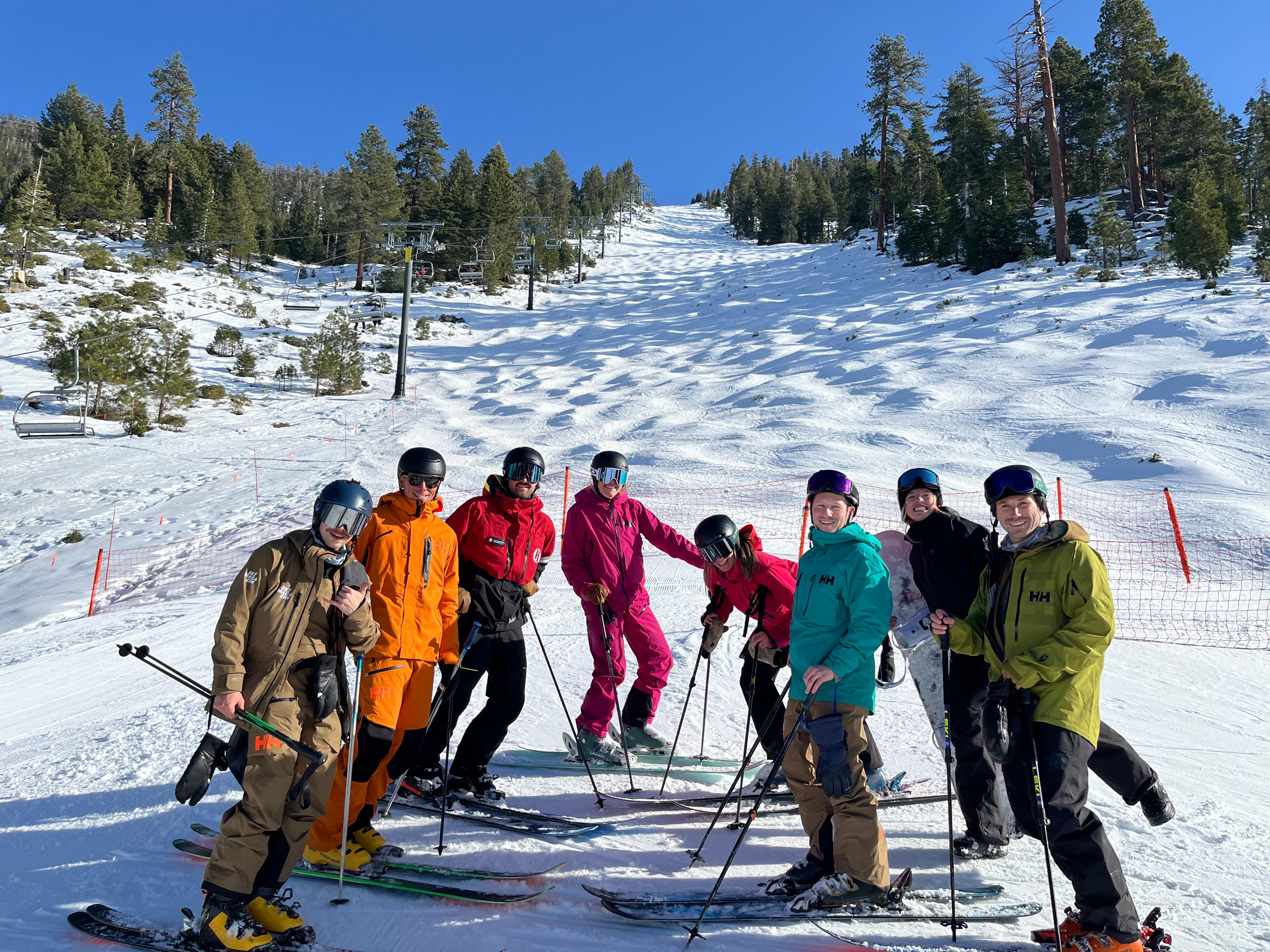
The Helly Hansen crew after a successful run down Gunbarrel
A few hours after leaving the breakfast diner, I’m staring down the barrel of “The Face,” aka Heavenly’s infamous Gunbarrel run. The drop below my ski tips plunges into sixteen hundred vertical feet of relentless moguls, stacked tight and unforgiving, spilling toward the glimmer of Lake Tahoe.
“See you at the bottom,” I shout over my shoulder before committing to the fall line.
The first few hundred feet feel rhythmic as I bounce through the bumps. By the next hundred, my legs are burning. I stop short atop the crest of one particularly big mogul halfway down, just in time to watch Marcus fly effortlessly past me, playful and precise, absorbing the troughs and springing gracefully through the air, turning chaos into choreography.
It looks less like survival and more like expression. On Gunbarrel, that difference matters.
Long before mogul skiing became a spreadsheet of turn scores and time points, runs like this were playgrounds. In the late 1960s, a new generation of skiers, the self-proclaimed “hotdoggers,” began rejecting the rigid alpine establishment. Racing was serious. Polished. Structured. Hotdogging was none of those things.
Much to the horror of traditionalists, the Hotdoggers skied bumps fast and loose and launched off natural kickers and invented tricks mid-run.
Wayne Wong, Doug Pfeiffer, Suzy Chaffee. They weren’t just skiing, they were pushing the sport into a new cultural realm rooted in freedom and style.
And in the spring of 1971, Heavenly hosted one of the first organized hotdog competitions in the West on Gunbarrel. It quickly became a regular stop on the early freestyle tour.
Back then, there were barely any rules. Skiers threw backflips, front somersaults, twisting aerials… whatever they could land.
But as popularity for mogul skiing grew, so did the structure around it. A handful of high-profile crashes in the mid-’70s led resorts to ban inverted flips. By the late ’70s, when mogul skiing came under the umbrella of the International Ski Federation, standardized formats replaced creative chaos. Wild playgrounds like Gunbarrel were replaced by dedicated courses and manicured jumps.
Style evolved with the scoring. Mogul skiers became smooth, fast, and controlled as they zipper lined down courses with tight skis and precise knees. The wild theatrics of the hotdoggers gave way to this new polished technique.
That is, of course, until decades later when Jonny Moseley rotated nearly horizontal in Olympic air and the rebellion that once defined freestyle found its way back into the spotlight.

Taking a selfie break halfway down Gunbarrel
-
Moseley was ahead of his time in 2002. Or, maybe, he had simply tapped back into something the sport had once suppressed.
At the time, mogul skiing lacked a formalized way to measure the true degree of difficulty of aerial maneuvers. But in the seasons that followed Salt Lake, that began to change.
The International Ski Federation expanded its aerial judging criteria, introducing a more structured degree-of-difficulty valuation system for moguls. Inverted and off-axis tricks were permitted in World Cup competition beginning in 2003, and by the 2006 Winter Olympics in Turin, front flips and back flips were not only legal, but were actually expected of athletes hoping to podium.
The Dinner Roll did not win gold, but it exposed the limitations of the system evaluating it. Mogul skiing did not become less structured, but it expanded to accommodate what athletes were already capable of doing.
In that sense, Moseley didn’t just throw a new trick. He forced the rulebook to evolve.
-
Now that the 2026 Milan-Cortina Olympics and Paralympics are underway, it’s worth remembering that the Games rarely reward innovation immediately. And not just in skiing, but across all sports.
This year, figure skating fans were wowed by Ilia Malinin landing backflips legally in competition for the first time. But the move’s legacy stretches back to 1998, when Surya Bonaly threw a one-footed backflip in Nagano, electrifying the crowd, but earning a deduction from the judges.
Progress, it turns out, is often penalized before it is accepted.
The first athlete to attempt something new is rarely the one who benefits from it. Instead, they are the one to expose the limits of the system.
From the defiant hotdoggers of the 1970s to Jonny Moseley at the Salt Lake Games, the pattern is familiar: the move that is against the rules today may be the one that defines tomorrow.